// Journal · Oct 23, 2026 · 6 min read
Why we built Citolume: measuring AI search citations
People increasingly ask ChatGPT, Gemini and Perplexity the questions they used to type into Google. When the answer does not cite you, you are simply absent — and nothing in your analytics will ever tell you, because there was no click to record. Search at least left a trace: a referrer, a query, a rank you could go and look up. This leaves none. It is a whole channel with no instrumentation on it.
That is the gap Citolume exists to close. We are Havoric, an AI automation and web development agency, and we kept running into this on client sites. The web work was done, the pages were good, and nobody could say whether any of it was being used by the systems that now answer a growing share of the questions. Not ranking badly. Unknown.
A plugin could only answer half the question
The obvious shape for this is a plugin. Most of the sites we work on run WordPress, and a plugin sits in exactly the right place to read server logs, serve an llms.txt, and record which AI crawlers came and what they took. We are building that. It is coming to the WordPress plugin directory, those parts run entirely on your own server, nothing is sent anywhere, and they will be free.
But a plugin can only answer half the question. It can tell you that a crawler arrived. It cannot tell you whether the answer cited you, because that happens somewhere a plugin has no access to: inside a conversation nobody on your side ever sees. A crawl is not a citation. Pages get fetched and never used. Pages get cited that were fetched weeks ago.
Answering the other half means somebody has to actually ask the engines, repeatedly, and compare what comes back. That is a service, not a plugin. So the service is what we launched first, and it works on any site, with or without WordPress.
Three decisions followed from that. Each one costs us something.
We use our own provider keys
The common approach is to ask the customer to bring their own API key. You connect your OpenAI account, the tool spends against it, and you find out what the measurement cost after it has been spent.
We pay instead. Every scan runs on our keys and the bill lands on us.
That has a consequence we wanted: we have to care what a scan costs. A single question costs us between 9 and 21 cents, depending on how many engines answer it and how much searching they do to get there. That number shapes the product — it is why sampling is deliberate rather than generous, and why a weekly run is the default rather than a live feed.
What it costs us is margin, and the freedom to be careless. What it buys you is a tool whose price you know before you run it. A measurement tool that hands you an unpredictable bill is one you will eventually switch off, and a measurement you switch off tells you nothing.
We ask every question several times
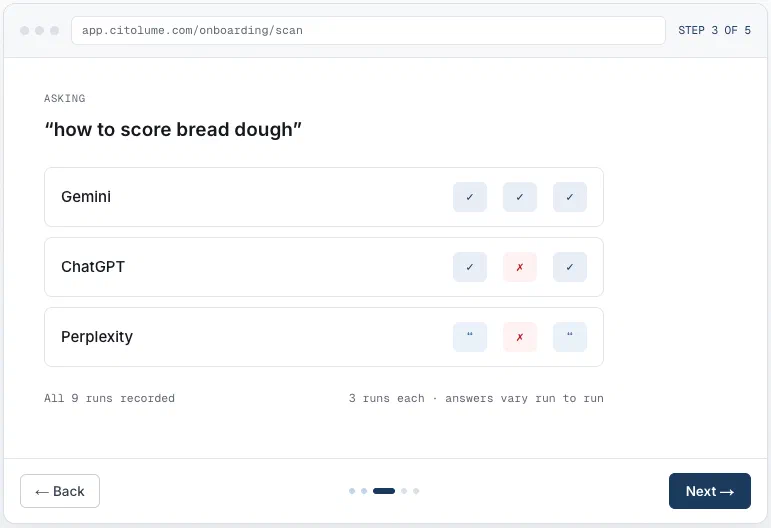
AI answers are not stable. The same question, to the same engine, minutes apart, does not reliably produce the same answer. We have measured ChatGPT citing the same site on two of three identical asks.
One ask cannot tell the difference between “not cited” and “not cited this time”. A tool that asks once is guessing, and then presenting the guess as a fact, with a tick or a cross beside it.
So we ask several times and store a rate over the samples. Cited in two asks out of three is a different statement from cited, and it is the true one. This costs several times more per question than asking once, which is the direct reason the first decision mattered. It is also the only honest way to report a number for something this noisy.
When an engine does not search, we say so
Engines decide for themselves whether to look anything up. They are not obliged to search because a question sounds like a search. Gemini decides per question — we have watched it be offered search as an option and answer from memory instead, fetching nothing at all.
A tool that records that round as “not cited” has told a site it is absent when nothing ever looked for it. That is not a small reporting flaw. It is the difference between a finding and noise.
So when an engine does not search, we report that we could not verify, and the sample does not count against you. It makes for a worse-looking dashboard: blanks where another tool would show a confident red cross. We will take that trade, because the negatives are the whole value of the thing. If you cannot trust “not cited”, you cannot trust anything else on the page either.
What Citolume does
It tracks the questions that matter in your field — real phrasings people put to an assistant, not keywords — and asks the engines on a weekly schedule, automatically.
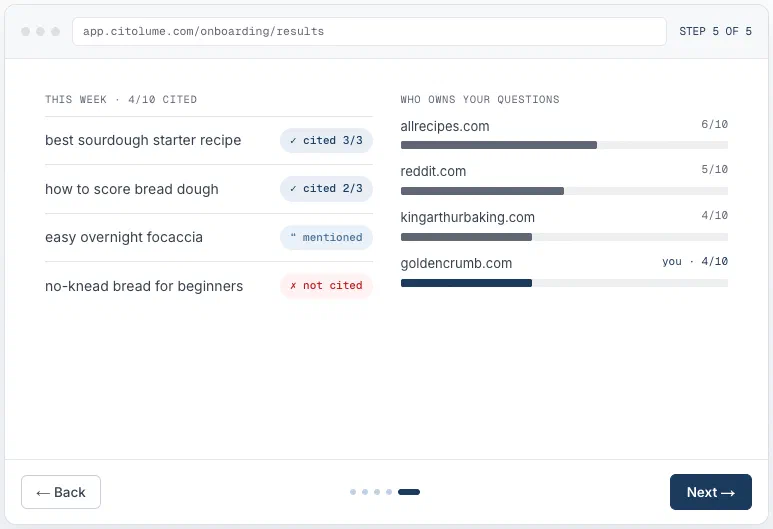
From that it shows which engines cite you, and which sites get cited in your place. That second view is usually the useful one, because being absent stays abstract until you see who is there instead. It separates being cited, where the answer links to you, from being mentioned, where your name appears with no link — different problems, with different fixes.
And when a page is not being used, it explains why, as far as the evidence allows: a crawler blocked in robots.txt, no llms.txt, structured data too thin to establish what the page is about, or the page simply never fetched at all. Those are fixable things, which is the point of naming them.
It works on any site. The WordPress plugin, when it arrives, will add the server-side half for the sites that run WordPress.
This is new, and we would rather measure it
We should be plain about where this stands. The category is young, the engines change underneath it, and a large share of what is currently written about AI search is guesswork in a confident voice. We do not have years of data. Nobody does.
What we have is a preference: measure it, say what the measurement can and cannot support, and leave the blanks blank.
Citolume has a free tier and needs no card, at citolume.com.
Common questions
- Do I need WordPress to use Citolume?
- No. Citolume is a hosted service and works on any website, on any platform, with or without WordPress. It measures AI citations by asking ChatGPT, Gemini and Perplexity the questions that matter in a site’s field and recording which sources each engine cites, so nothing needs to be installed on the site itself. Havoric is also building a WordPress plugin that adds the server-side half — AI crawler logs and llms.txt — but that plugin is still in development and not yet released, and Citolume does not depend on it.
- Why not just ask ChatGPT whether it cites my site?
- Because the answer varies between asks, which is the problem the measurement exists to solve. Havoric has measured ChatGPT citing the same site on two of three identical asks, minutes apart. A single ask cannot distinguish “not cited” from “not cited this time”, so one answer is a sample, not a result. Citolume asks every tracked question several times and reports a citation rate over those samples rather than a yes or no.
- What does Citolume cost?
- Citolume has a free tier and no card is required to start, at citolume.com. Paid plans exist for more tracked questions and more frequent scans. Scans run on Citolume’s own provider API keys rather than the customer’s, so there is no separate, variable bill from OpenAI, Google or Perplexity on top of the plan price.
- Can Google Analytics show AI search traffic?
- Only partially. Analytics records a visit when someone clicks a link inside an AI answer, usually as a referral from chatgpt.com, perplexity.ai or gemini.google.com. It records nothing at all when an assistant answers the question without a click, which is the common case, and nothing when a competitor is cited instead. That blind spot is why AI citations have to be measured by asking the engines directly rather than by reading server-side analytics.